14.07.2026
News
The EU’s Forced Labour Regulation Enters Its Countdown: What this means for Your Supply Chain
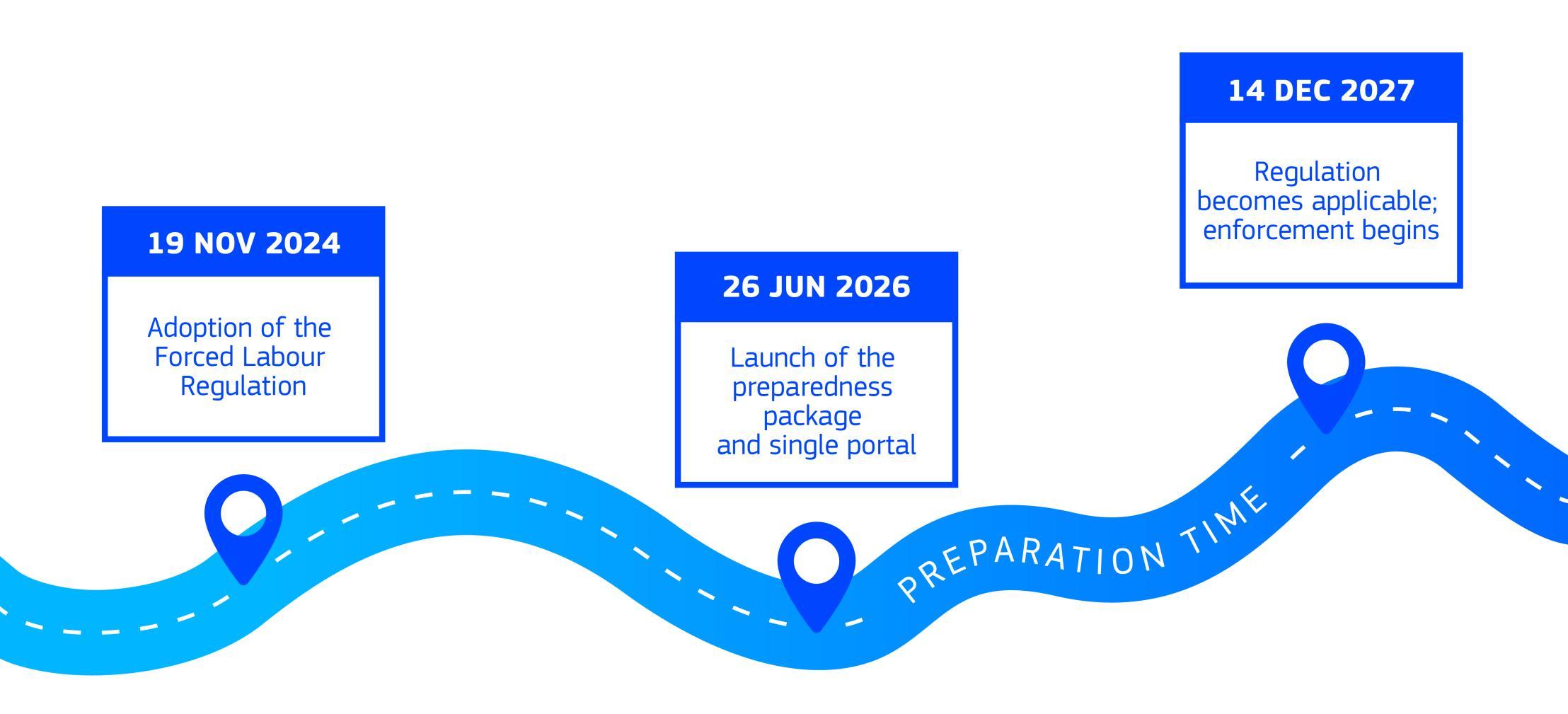
On 26 June 2026, the European Commission launched the Forced Labour Single Portal, a central hub supporting the EU Forced Labour Regulation (Regulation (EU) 2024/3015). Alongside the portal, the Commission released its official implementation guidelines and a preparedness package, including an anti-forced-labour checklist for SMEs. Together they mark the start of an 18-month countdown to enforcement and the clearest signal yet of what businesses will be expected to demonstrate.
The message from Brussels is unambiguous: preparation starts now. With an estimated 27.6 million people in situations of forced labour worldwide, the Regulation draws a firm line; from 14 December 2027, no product made with forced labour may be placed or made available on the EU market, or exported from it.
In this update, we break down exactly what the EU Forced Labour Regulation requires, when it applies, and how it will affect your business. You can find the official materials on the European Commission's Forced Labour Single Portal, we've distilled what matters most.
What the regulation is
The Forced Labour Regulation prohibits products made wholly or in part with forced labour at any stage of extraction, harvesting, production or manufacturing, whether that stage takes place inside or outside the EU. It applies regardless of a product’s origin, type, sector or value, and covers manufactured goods, agricultural products and extracted raw materials alike. Products sold online to EU customers are equally in scope.
Crucially, the Regulation imposes an “obligation of result”. It does not create a new, standalone due diligence duty, but it holds economic operators responsible for ensuring that the products they place on the market are free of forced labour. The prohibition is described by the Commission as “unconditional and absolute”.
Strong due diligence does not exempt a product from the ban if forced labour is present in it. What it does is shape the risk assessment: authorities must take account of the measures an operator has taken to identify, prevent and remediate forced labour when deciding whether a concern is substantiated. Due diligence and traceability are not a legal defence, but they are what separates answering a query with evidence from facing a full investigation.
The dates that matter
Who it affects
The Regulation applies to all economic operators placing products on, making them available on, or exporting them from the EU. It applies to companies of all sizes, with dedicated support available to SMEs.
Enforcement follows a risk-based approach. The Commission and national authorities will prioritise cases by the scale and severity of the suspected forced labour, the volume of affected products on the market, and the significance of the affected component within the final product.
Enforcement runs in two stages. In a preliminary phase, authorities assess the information available and may ask an operator to explain how it identifies and addresses forced labour risks in its supply chain. Only where a substantiated concern remains does a formal investigation follow. This matters for preparation: an operator that can evidence a clear view of its supply chain and the steps it takes to manage risk stands the best chance of resolving questions at the preliminary stage, before a full investigation begins. Where a violation is confirmed, authorities can order products to be withdrawn, disposed of, or refused at the border, with financial penalties for non-compliance with a ban decision.
Ban decisions also reach beyond the company investigated. A decision applies to the named product wherever it is placed on the EU market, and every decision is published on the Single Portal. A ban arising from an investigation into one of your suppliers, or a competitor who shares that supplier, can therefore affect your own products directly. Monitoring published decisions becomes part of staying compliant.
What you need to do to meet it
Although the Regulation does not mandate a specific due diligence method, the Commission is explicit that due diligence and supply chain traceability is the most effective way for a company to show its products are clean. Its guidelines point to the internationally recognised OECD six-step framework:
- Embed forced labour risk into company policy
- Identify and assess risks across operations and supply chains
- Prevent, mitigate and cease those risks
- Monitor results
- Communicate how they are addressed
- Remediate where harm occurs.
In practice, three jobs sit at the heart of readiness, each depends on the same foundation of supply chain visibility:
Know where your products really come from. You cannot evidence what you cannot see. Full visibility to the mine, farm or facility is the goal, but it does not have to arrive all at once. The Commission's approach is risk-based and proportionate, so the sensible path is to map what you can see now, prioritise the highest-risk materials and regions, and extend coverage over time. Platforms that trace material provenance end to end, such as Circulor's Prove, are built to make multi-tier supply chains visible rather than assumed.
Focus effort where the risk is. The Commission’s risk database will flag high-risk geographies and products; the task for businesses is to overlay that against their own supply base. Continuously scoring suppliers, materials and regions for forced labour risk, and surfacing anomalies automatically, turns a periodic audit into an early-warning system.
Be ready to prove it. When an authority asks how you manage forced labour risk, the difference between a swift resolution and a costly investigation is the quality of your records. A durable, tamper-evident audit trail, cascading obligations and codes of conduct down the supply chain and tracking adherence, lets a company respond with evidence rather than assurances.
Preparation is the differentiator
The Commission is running a programme of sector-specific webinars through late 2026. Covering solar, textiles, electronics and semiconductors, agri-food, automotive and fisheries, a clear indication of where enforcement attention is likely to concentrate. Understanding your supply chain, the Commission notes, reduces legal, financial, operational and reputational risk, and protects businesses that already uphold high labour standards from being undercut.
Circulor will continue to monitor developments across the Forced Labour Regulation and the wider EU regulatory landscape and to share practical guidance as implementation approaches.
About Circulor
Circulor provides supply chain traceability and digital product passport solutions designed to support responsible sourcing, cross-border trade facilitation and regulatory compliance across complex industrial supply chains.




© 2026 Circulor
Product
Stay connected
Get the latest Circulor updates, in-depth information on industry developments and commentary from our experts to your inbox.